



And you think it’s tough finding a parking spot during the holidays.
With only one parking space for every 11 commercial trucks on the nation’s roadways, the state of Ohio and ODOT have announced a two-year program to make in-roads on this growing dilemma.
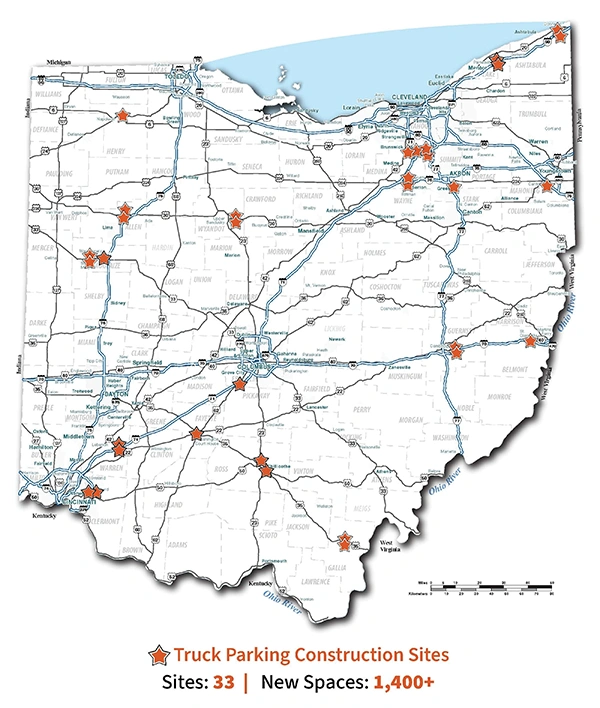
In late July, Ohio Gov. Mike DeWine announced a plan to add 1,400 new truck parking spaces across the state by the end of 2027. For the industry that accounts for more than $1 trillion in freight delivery to, from and across Ohio annually, truck parking is a critical logistical concern.

“The truck parking issue has been one that has been ongoing for a very, very long time,” said Ohio Trucking Association’s (OTA) Tom Balzer.
According to the OTA president/CEO, the truck parking shortage is a top concern among trucking industry members in an annual survey by the American Transportation Research Institute (ATRI). “The No.1 issue, even above drivers’ own pay was truck parking,” Balzer said. “There is a huge shortage of truck parking, and we see it every day with trucks that are parked on on-ramps and off-ramps and on the side of the road. The need for truck parking is glaringly obvious.”
Not Just a Parking Issue for the Trucking Industry
As one of the top 10 states in the nation for trucking, according to the U.S. DOT’s Bureau of Transportation Statistics, Ohio currently has approximately 14,300 designated public and private truck parking spots – with nearly 80% privately maintained. Four of every five truck parking spots in Ohio are privately maintained truck centers, such as Flying J, Love’s Travel Stops, Pilot Travel Centers, Travel Centers of America (TA), etc. Though Ohio’s current quantity of parking is among the most of any state there is a critical need for more, as many commercial truckers spend the last hours of their driving day searching for available places to park and rest.
Perfectly situated within a day’s drive of 60% of the U.S. and Canadian population, Ohio is one of America’s most critical freight corridors. In 2023 alone, trucks logged 27.5 million miles on Ohio roads, and ODOT estimates that freight volume will increase 26% by 2045. (Source: ODOT)

ODOT Statewide Freight & Maritime Manager Randy Lane said the state’s truck parking dilemma has been studied for years prior to July’s announcement of the Ohio Truck Parking Mega-Projects. Referencing a 2021 ODOT study, Lane said, “That’s when we really started focusing on the ‘undesignated truck parking.’ Those are the trucks that are parking on our ramps, those are the trucks that are parking on our local roadways for staging or for near-delivery time, parking along our interstate shoulders.” A 13-year ODOT veteran, Lane said trucks parking in undesignated areas “are causing safety issues for both them and other members of the traveling public …
“When you have trucks parking in areas where the facility isn’t designated to accommodate parking in those locations, that presents a safety hazard,” he added.
According to an ODOT release from the July 2025 announcement of the truck parking mega-projects, “… 689 crashes were caused by drowsy semi-truck drivers in Ohio since 2015, resulting in 345 injuries and two fatalities.” Lane notes that distracted driving also leads to “potential safety conflicts,” as motorists aren’t expecting to see trucks relegated to using undesignated parking areas on ramps and roadway shoulders.
According to Michelanman.com, the U.S. has a shortage of more than 40,000 truck parking spaces, resulting in nearly two of every three (63%) commercial motor vehicle (CMV) drivers needing upwards to an hour a day looking for a place to park. A Michelanman.com blog, “Truck Parking: Why It’s a Top Issue for Drivers,” looked at causes and effects the parking shortages has on the overall trucking industry.
Causes
- Not enough spaces for the number of trucks
- (Editor’s note: Exacerbating the parking issue is that according to the Bureau of Transportation Statistics, the nation’s number of truck registrations increased 61% from 2008-2023)
- Stricter hour-of-service (HOS) regulations
- Truck drivers must stop driving when hours are met, whether parking is available or not – resulting in many to park illegally on ramps/shoulders, which increases safety risks
- Urban and last-mile delivery challenges
- City ordinances can restrict truck parking, resulting in urban fleets struggling to find safe parking near drop-off points. (Editor’s note: According to Transport Ohio’s Working Paper 3: Truck Parking Inventory (2021), only 27% of designated trucking spots are located in urban areas)
Effects
- Lost productivity & increased fuel costs
- Fleets lose an average of $5,500 annually per driver due to parking-related delays
- Increased safety risks
- Illegal/undesignated parking spots increase accident risks and liability for citations
- Decreased driver retention
- Parking stress is one of the top reasons truckers leave the industry. Fleets offering better parking solutions attract & keep more drivers.
According to the Federal Highway Administration’s (FHWA) Freight Management & Operations (FMO), truck parking is a national challenge. “An inadequate supply of truck parking spaces can result in two negative consequences: first, tired truck drivers may continue to drive because they have difficulty finding a place to park for rest; and second, truck drivers may choose to park at unsafe locations, such as on the shoulder of the road, exit ramps, or vacant lots …” This scenario ended in tragedy in March 2009 when New York truck driver Jason Rivenburg was enroute from Virginia to a delivery in South Carolina. According to FMO: “While only 12 miles from the delivery location, (Rivenburg) needed to find parking to rest through the night, as his arrival location was not yet open to receive deliveries. Jason did not have a safe place to park. Jason had learned from truckers familiar with the area that a nearby abandoned gas station was a safe location to park and (he) proceeded to park there for the night … He was attacked and murdered at this location while he slept, with his killer taking both his life and just $7.00 that he had in his wallet.”
Rivenburg’s death prompted “Jason’s Law” to be established and included in the 2012 federal transportation bill Moving Ahead for Progress in the 21st Century (MAP-21). Jason’s Law makes the shortage of long-term parking for CMVs a national priority. This has resulted in:
- Evaluating states’ capabilities to provide adequate parking/rest areas for CMVs engaged in interstate transportation
- Assess CMV traffic in each state
- Develop metrics measuring the adequacy of CMV parking facilities in each state
Ohio’s Push for Trucker Safety
This year’s announcement of Ohio nearly doubling its amount of designated truck parking spaces is the latest initiative undertaken by the DeWine Administration to address the issue. In his, thus far, seven years leading the state, Gov. DeWine is credited with helping the commercial truck industry’s access to designated parking spaces across the state:
- 2019 – Ohio, along with other Midwest States, launched a Truck Parking Information Management System (TPIMS), which provides real-time information about parking availability through digital signage and in-cab systems. According to truckparkingclub.com, eight states utilize TPIMS: Ohio, Indiana, Iowa, Kansas, Kentucky, Michigan, Minnesota and Wisconsin.
- 2022 – 144 truck parking spaces were created by converting more than a dozen unused weigh stations.
- 2023 – an initiative was announced to “re-imagine and modernize” 36 rest areas throughout the state – which includes the addition of 401 truck parking spots
- 2024 – 138 spaces were added to Ohio’s designated truck parking inventory from abandoned rest areas in Preble and Trumbull counties
- 2025 – the Ohio Truck Parking Mega-Project was announced, which will provide the addition of 1,400+ designated trucking spaces in Ohio
In reference to the state’s nearly 2,100 truck parking spaces to be added during his administration, Gov. DeWine said, “As Ohio’s economy continues to grow, so do the number of trucks traveling on Ohio’s network of interstates and state routes. By expanding safe, accessible places for drivers to rest, we’re supporting the people who keep our economy moving and making it safer for everyone on our roads.”
Talking about the positives of Ohio’s designated trucking area additions, Balzer said, “Anytime anybody invests in highway safety, highway improvement projects – especially when we’re talking about truck parking – it will have a direct impact on our industry. Whether it be better roads and better construction that cause less maintenance issues and less maintenance costs – that is a net positive for us.” The 12-year OTA leader added, “With truck parking and driver efficiencies being increased by the knowledge that there is available truck parking for them, they don’t have to worry about that and shut down early in fear of not being able to find a parking spot.”
Priority Parking
Initial work on the Ohio Truck Parking Mega-Project coincided with ODOT Director Pamela Boratyn’s appointment in October 2024. ODOT District 1 Deputy Director Chris Hughes said with Gov. DeWine and Director Boratyn recognizing truck parking expansion as a high priority, “brainstorming conversations” were held with ODOT Assistant Director of Field Operations Mitch Blackburn about how to provide “major expansion of truck parking in the state in a short amount of time.”
Those early discussions led to the $150 million, two-year project, which ODOT District 1 is taking a leading role in its development. Funding for the mega-project was included in ODOT’s biennial budget passed earlier this year.
According to Hughes, following the initial brainstorming, conceptual development and design contracts were released and accepted by December 2024. “The next question,” said Hughes, “was: ‘Where are we going to build this?’ … So, what we did was we canvased all 12 districts and said: ‘We’re looking at ODOT-owned land.’ Given the timeline, we did not have time to purchase land for this project. We were looking at land the state already had control of, which was next to major freight corridors – and we were looking for large sites.”
Using the initial criteria, the 12 ODOT districts came up with 100 potential sites, which Hughes said was trimmed to 83 viable locations. “This is a statewide effort,” said the 20-year ODOT veteran. “So, we wanted to make sure that when you look at a map of the state of Ohio you could say, ‘OK, we’re building truck parking all over the state.’” Of the 83 candidate sites, 33 were agreed upon. (See “Truck Parking Ahead” on page 18 for listing.)
“Some of the sites are existing rest areas where we have excess land and we’re going to add parking areas … Some of them are non-existing rest areas; they’re on vacant land of one form or another,” said Hughes. Of Ohio’s 93 rest areas, currently 75 provide truck parking. New designated parking locations will also be found in interchange infields and former weigh stations. “We asked our consultants: ‘Give use some alternatives that we can pick from in terms of different numbers of parking spaces and how those layouts fit on the site.’”
Nationally, according to an April 2025 ATRI report, “Expanding Truck Parking at Public Rest Areas,” there are 1,784 rest areas (with 47 states taking part in the study). Of these rest areas, 90% (1,598) provide truck parking. The state average for designated trucking spots at rest areas is 662 – with Midwest states (Ohio, Illinois, Indiana, Iowa, Kansas, Michigan, Minnesota, Missouri, Nebraska, North Dakota, South Dakota and Wisconsin) averaging 836 trucking spots per state. On average, there are 21 truck parking spaces per rest area in the study’s 12 Midwest states.
After the 33 sites were selected, consulting firms were tasked with providing conceptual layouts for each location so the number of truck parking spots could be maximized. Parking styles for trucks – such as parallel, pull-through or back-in/reverse angle – each have individual requirements for maneuverability. Currently at Ohio’s rest stops, pull-through parking is available almost 2:1 compared to parallel parking; however, it is “space expansive.”
According to truckparkingclub.com, “… Truck parking spots require plenty more space than one might initially expect.” The website’s article, “Truck Parking Lot Layout & Dimensions: How to Design a Truck Parking Lot,” listed dimension standards such as minimum parking space widths and lengths, maneuvering and backing area, outer turning radii and vertical clearance – all with individual space requirements ranging from 9 to 60 feet. Planning models show reverse back-end parking accommodates up to 53% more trucks than pull-through parking.
Ohio’s 1,400 new truck parking spots will utilize all forms according to Hughes. “Going along with the theme of maximizing parking – and focusing on needs and not wants – we have really tried to maximize and get the most bang for the buck and try to get the most parking spaces possible. What that has led to is that you’re going to see parallel; you’re going to see pull-through; you’re going to see 90-degree parking; and back-end reverse parking.”
Balzer complimented the state’s efforts, saying, “One of the most innovative things that ODOT did in this planning is that they looked at the number of spots and the square footage utilization of these areas.” While pull-through parking is considered the easiest method, he said truck drivers’ skill levels make them adaptive. “These drivers are professional truck drivers and are very skilled at what they do, and they can park these vehicles in some very difficult situations on a day-to-day basis.”
Note to Contractors: ‘Sharpen Your Pencils’
With 1,400-plus publicly maintained designated truck parking spaces – some reports note more depending on parking design – being added at 33 locations throughout Ohio, ODOT is expecting high interest from the heavy/highway construction industry.
“It’s the types of work that should be very inviting to a large number of contractors,” said Hughes, as approximately one-third of the mega-project’s contracts will be let in March 2026 – with construction to be completed by the end of 2026 – and the remaining contracts to go to bid in late-2026 for completion in 2027.
“We’ve tried to stay very focused on truck parking only,” said Hughes in describing the projects’ work scopes, which entails:
- Ingress/Egress (drives, ramps, etc.)
- Parking Lots
- Drainage
- Lighting
- Trash Facilities
- Signing/Striping/Traffic Control
- Post-Construction Best Management Practices
Whether an expansion of an existing rest area or new standalone site, Hughes said contractors will be providing “the parking lot itself, along with ingresses and egresses – whether that is ramps, whether that’s existing ramps, brand new ramps, whether it’s just driveway access … There is going to be curbing, there’s going to be lighting – so there will be some electrical work – and that is just about it. Of course, there is maintenance of traffic, drainage and the other things that come with site work, but we really tried to in terms of amenities keep this to a needs-and-a-not-a-wants sort of thing.”
Lane interjected that because each of the parking sites will be let through individual contracts, contractors can bid either an asphalt or concrete option.
Along with lighting, the designated trucking lots will also have restroom facilities – however, they will be provided through separate contracts. While current rest areas being expanded as part of the truck parking mega-project already have restroom facilities, the new locations will feature “primitive, pit latrine restrooms.”
“‘Primitive’ is an interesting term,” Balzer said smilingly, as he mentioned his North Dakota roots. “They are not outhouses like people think they are. They are pit latrines that you find in most national parks and state parks.”
While the new parking facilities may be spartan-like when it comes to amenities, Balzer said the trucking industry is aware of the limited amount of funds and the impact the finished mega project will have. “We are not going to scoff at 1,400 parking spots – basically doubling the amount of parking spots in the state – because they’re pit latrines … I think the biggest thing for us is security lights, making sure the facilities are safe – especially for our female drivers.”
ODOT is hoping contractors find these projects appealing. “We certainly want to see a lot of contractors show interest in these projects … big contractors, small contractors. I think there is room for all to participate,” said Hughes, who added: “ODOT’s advice to contractors is: ‘Hey, sharpen your pencils. We want to see a lot of bids.’”
“I don’t have any concerns,’ said Lane of the mega-projects’ two-year timeline. “I feel that we have done a lot of due diligence on this. A lot of other states are hesitant to act … Because they may not have the resources to act like we are fortunate to have, or they struggle to figure out where to put it and how much to put.”
Balzer said Ohio’s truck parking expansion is speaking volumes nationwide. “I think it proves without a shadow of a doubt that Ohio is committed to being a logistic leader in the country, and trucking is the mode that they see as one that supports and drives the economy … They can see the importance of making sure truck drivers have a safe and available parking spot.”
For more information on Ohio’s Truck Parking Mega-Project, visit: https://www.transportation.ohio.gov/projects/mega-projects/mega-projects/truck-parking.