


Heavy-construction contractors have built a reputation for adaptability. So, it’s no surprise that the industry that helped expand the United States’ early road system into superhighways is now preparing to bolster the nation’s early information highway systems into information superhighways.
An integral part of the federal Infrastructure Investment & Jobs Act (IIJA) is a nearly $42.5 billion grant program called the Broadband Equity, Access & Deployment Program (BEAD). According to the U.S. government’s Internet For All, the goal for BEAD is to “get all Americans online by funding partnerships between states or territories, communities and stakeholders to build infrastructure where we need it to and increase adoption of high-speed internet.”
Just as the nation’s reliance on a strong transportation system has occurred, the same has become true for an increased reliance on broadband communications. The Internet For All government website touts: “The Internet is the Backbone of Today’s World.” Statistics from zippia. com backs up that claim, as it reports that more than six of 10 humans in the world are active internet users; in the U.S., 93% of the population are internet users.
“Access to the Internet isn’t a luxury. It’s a necessity … High-speed Internet doesn’t just help individuals,” according to Internet For All. “It helps our country. It saves us time and money. It creates jobs and opportunities here in the United States. And it helps us connect to one another, building a stronger, more free society.”
While U.S. Secretary of Commerce for Communication & Information Alan Davidson talks of the positives of a strong broadband internet system, saying: “Access to Internet service is necessary for work, education, healthcare and more,” other officials paint a gloomier scenario for areas not having strong internet service. Maine’s ConnectME Authority’s Peggy Schaffer said in Trust Magazine that any community without fast, reliable internet is condemned “to a long, dark death.”
The growing reliance on broadband telecommunications – and the fact one in five (20%) of U.S. households still don’t have the infrastructure in place to be connected to the internet – has prompted the inclusion of BEAD in the IIJA.
According to the Associated General Contractors of America (AGC), “With $42 billion in funding from the IIJA, the BEAD program will help ensure universal internet access for all Americans by funding states to extend broadband infrastructure to unserved and underserved areas with limited or no internet access.”
“Every dollar invested in broadband returns nearly $4 to the economy.”
– Trust Magazine
Ohio saw the need to expand highspeed internet when it released its Ohio Broadband Strategy in December 2019. A key part of the plan included the formation of BroadbandOhio, which is housed in the Ohio Department of Development (ODD).
BroadbandOhio
ODD Director Lydia Mihalik sees the federal BEAD program – and its more than $793 million in grant money to the state – as a major step toward expanding Ohio’s broadband offerings. “This funding, made possible by our partners in the federal government, puts us another step closer to closing the digital divide in Ohio,” she said. “With roughly 300,000 addresses still lacking reliable and affordable broadband connectivity, we are more than ready to use this funding to bolster our efforts and continue making a difference in our communities.
Taking BEAD
Examples of how BEAD funds can be utilized by states, include:
- Planning for the deployment of high-speed internet, including conducting research, collecting data, outreach and training
- Deploying or upgrading internet in unserved and underserved areas or improving service to
anchor organizations - Installing internet and Wi-Fi in multi-unit residential buildings
- Adoption and digital equity programs
- Workforce development programs and vocational training
(Source: InternetForAll.gov)
There are several factors why Americans do not and cannot utilize broadband internet. According to an Internet Use Survey of U.S. households conducted by the National Telecommunications & Information Administration (NTIA), nearly 22% said broadband connection was “too expensive,” “not available” or because of having “no computer.” The 300,000 Ohio households ODD Director Mihalik referenced for having a lack of broadband access represents approximately one million Ohioans. According to BroadbandNow, Ohio’s internet coverage speed and availability in 2023 ranked 38th in the nation.
“This means that roughly one in 10 Ohio residents are not able to purchase an internet plan of at least 25 megabits per-second (Mbps) download and 3Mbps upload,” according to BroadbandNow, an independent research group based in Los Angeles. A megabit is a measurement of how quickly information can be sent online.
Up to Speed?
The internet was invented in the 1960s during the Cold War for use by the U.S. Defense Department as the Advanced Research Projects Agency Network. By the 1980s, the term “internet” became popular and by the late 1990s was being used more and more – as world internet usage grew from 16 million to nearly 250 million people from 1996-2000. It was also in the late 1990s that internet users were having better experiences online with the introduction of broadband, as broadband replaced the days of dial-up 56-kilobit (k) internet modems. An example of how improved internet speeds made its use more convenient, an article in Quartz (“From Dial-up to 5G: A Complete Guide to Logging on to the Internet”) wrote that 56k allowed “internet users to surf the web at a blistering 56,000 bits per second. Today, we can download a 1 GB (Gigabyte is equivalent to more than 1 million k) file in about 32 seconds, compared to around 3.5 days, which is what it would take on a 56k modem.”
Prior to becoming president/ executive director of the Ohio Utilities Protection Services (OUPS/OHIO811), Roger Lipscomb was involved in aerial and underground computer network systems. Familiar with the telecommunication industry’s transition from copper to fiber network lines for internet, Lipscomb said, “Those first networks just couldn’t handle the traffic. They were just too slow.
“When broadband came about, it escorted in the need for bigger freeways,” Lipscomb explained of the increase in data traffic and the need for larger-capacity network lines. “Think about how we went from two lanes on the highway, to three lanes on the highway, to four lanes on the highway, five lanes on the highway. This is what broadband really is, being able to expand this.
“Part of what’s coming out of this BEAD program is how do we take this highspeed connection the final mile? How do we take it into the rural areas … to these underserved areas?” Lipscomb added.
Haves & Have-Nots
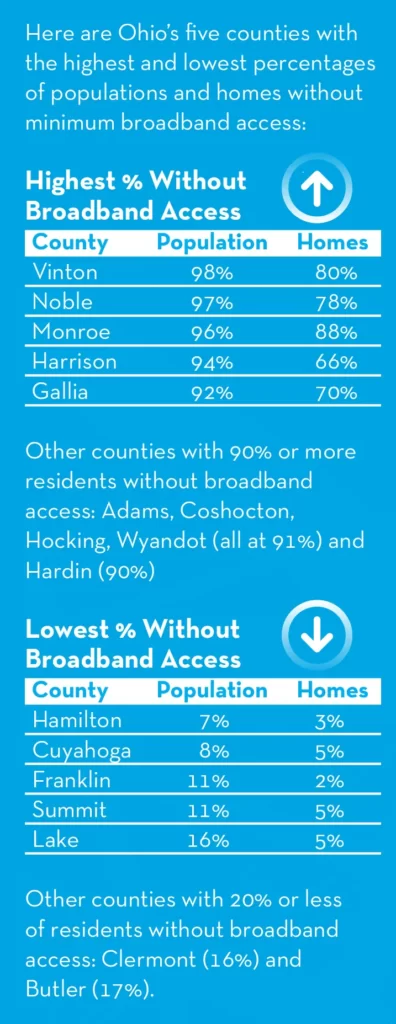 A look at Ohio’s broadband infrastructure provides a true picture of areas in the state having sufficient internet capability and areas that don’t. While broadband internet infrastructure is providing nearly 90% or more of Ohio residents with connection speeds of at least 25 Mbps for downloads and 3 Mbps for uploads, 50 of the state’s 88 counties, have 75% or more of their residents without highspeed broadband access.
According to BroadbandOhio, a location is considered “unserved” if it has internet speeds at or below 25 Mbps download/3 Mbps upload, while “underserved” locations consist of available internet being below 100 Mbps download/20 Mbps upload.
“The greatest connectivity-based challenge facing Ohioans today is access to at least one internet service provider that can offer reliable and affordable options for high-speed connectivity,” Mihalik said. “These days, that type of infrastructure is no longer a luxury – it’s a necessity for participating in the modern economy. So many Ohioans rely on the internet to complete everyday tasks, such as working remotely and gaining an online education to staying in touch with loved ones and even seeing a doctor.”
Taking a BEAD on Program Planning
Ohio’s $793 million allotment of available BEAD grants was based on its number of unserved and underserved locations for broadband internet. According to AGC, each state received a baseline allocation of $100 million, with additional funding calculated and divided by the nationwide total of unserved and underserved broadband internet areas.
This December 27 is a key date regarding BEAD funding, as states must submit a “BEAD Initial Plan” to the NTIA outlining strategies, goals and initiatives they intend to use in addressing broadband access and deployment. The BEAD Initial Plan’s late-December deadline marks 180 days from when states received their BEAD allotment amounts. Included in this 180 days, each state is required to post their plans for a 60-day public comment/review period. According to BroadbandOhio, it will post Ohio’s BEAD Initial Plan online at https:// broadband.ohio.gov/ for comment/ review in August or September.
Construction Ahead
While Mihalik looks at 2024 as when BEAD grantees are chosen, she believes 2025 will be when most of the broadband infrastructure will be built. “… There will be broadband projects throughout the state, requiring miles of fiber optic cable to be run, large poles to be constructed, and towers to be built to completely cover every address with high-speed internet,” she said.
While fiber lines may differ from the materials most contractors are used to installing, Lipscomb said it shares similarities to placing copper wire, electric cable and plastic pipe. “The infrastructure itself, the installation of fiber cable down your street, is no different than installing a telephone pole cable down your street,” he said. “Some of the apparatus may be different, but as far as the physical installation, the same practices are the same as virtually any utilities … The practice of whether directional drilling it under the ground or the practice of hanging it off the utility poles, those techniques, the equipment, the materials are all going to be very similar practices of what contractors have been installing for generations.”
However, the abundance of broadband infrastructure work on the horizon is expected to stretch Ohio’s already thin number of construction workers.
“We also recognize we need the workforce to build the network of the future,” Mihalik said. “That is why we are in ongoing conversations with the Governor’s Office of Workforce Transformation to make sure Ohio is prepared for these large projects.”
Lipscomb agrees. “One of the things broadband is showing us right now is a shortage of workers. We are seeing the large utility companies hiring subcontractors to build all this infrastructure out to the rural areas … What this is leading to,” he said, “is an influx of out-of-state workers coming to Ohio, many of which are fully Spanishspeaking crews …” Though this tests OUPS/OHIO811’s agreement with companies to have at least one Englishspeaking bilingual person on the crew, Lipscomb said his organization is preparing for the influx of non-bilingual workers. “We have started converting all of our education materials, all of our training – the universal marking standards used in Ohio to identify various utilities – to Spanish, so, we can educate that new population about the importance of ‘Call Before You Dig’ and notify before you dig … We can talk with them on the importance of understanding about being safe around utility poles; how to be safe around open trenches …”
Regardless of the language spoken on the crews, Lipscomb stresses safety when BEAD program work commences. “Make sure you get the proper materials and education into the hands of these workers. If you’re hiring subcontractors to help support you, and you are giving those subcontractors the ability to hire subcontractors of their own, please make sure the high-quality of standards you hold your people to you’re holding those subs to … We have to have that safety in the field; that’s where we run into problems. Not the people that are Ohio Contractor members,” Lipscomb added, “that’s the elite of the elite – they hold themselves accountable and they hold their people accountable. The problem is that when they have to hire other people.”
BEAD & BUY AMERICAN
Just as heavy/highway contractors are dealing with Buy American requirements in their work on projects funded through the Infrastructure Investment & Jobs Act (IIJA), Brookings Institution’s Blair Levin said contractors can expect the same when it comes to the $42.5 billion Broadband Equity, Access and Deployment (BEAD) Program.
Levin, a nonresident senior fellow of the Washington, D.C.-based non-profit organization that conducts nonpartisan research to improve policy and governance, sees Buy American requirements being a major disconnect when it comes to connecting the unserved and underserved to broadband internet. He writes: “The problem is that the country can close the rural digital divide in the next few years, or it can enforce a strict Buy American mandate. It cannot do both – requiring the administration to decide which principle it wants to prioritize over the other.”
When it comes to the Biden Administration and BEAD, Levin believes the 100% Buy American requirement of construction materials should be waived for specific components currently not produced in the U.S. His reasoning is because 90% of BEAD’s $42.5 billion will go toward American labor and materials.
With less than 10% of broadband network’s critical elements “sourced exclusively from Asia,” Levin said Buy American’s exclusive Made in the USA requirement would result in those constructing the networks to halt plans “until they convince enterprises capable of manufacturing those components to do so in the United States … This would mean further delays until new facilities are constructed and start to produce a sufficient supply of components.” A study by the National Telecommunications & Information Administration predicts this would take 24 to 36 months to occur.
Levin concludes in his commentary (“Biden’s Buy American Policy Could Put Broadband Deployment at Risk”): “In short, if Buy American requirements delay BEAD-funded deployments, the costs to deploy networks will be higher and the expected market returns will be lower – resulting in the BEAD dollars reaching fewer unconnected Americans …
“The whole process will grind to a halt,” he adds. “Plans for thousands of American construction and installation jobs would be jettisoned, millions of Americans would remain disconnected, and the potential for economic growth and job creation in unconnected areas would be unrealized.”