


There are five areas in Ohio’s new underground utility digging standards that went into effect in early June:
- Notification Timelines
- Exemptions
- Training
- Mandatory Damage Reporting
- Damage Reporting Data
“It eliminates any questions …,” said OCA Director of Labor Relations & Safety Dave Coniglio of House Bill 227, which became effective June 9. “It helps the industry better understand what’s in the (Ohio Revised Code 3781), and in addition we further defined and changed some things in an effort to make it safer when working around utilities.”
HB227 amends ORC 3781, which went into effect in 2013 and helped define the state’s timelines, responsibilities and damage protocols for excavators/homeowners working near underground utilities.
“HB227 enhances clarity, strengthens accountability and unites all stakeholders behind a shared goal: ‘Advancing public safety through increased communication resulting in a safer Ohio.’”
OHIO811 Public Awareness/Services Supervisor Jason Broyles, who has been with the “Call Before You Dig” agency since 2017, said, “HB227 enhances clarity, strengthens accountability and unites all stakeholders behind a shared goal: ‘Advancing public safety through increased communication resulting in a safer Ohio.’”
Anything making work safer for field personnel at George J. Igel & Co. Inc. and in Ohio’s heavy/highway construction industry is a win for Mary Logan So. The 2025 recipient of OCA’s Past Presidents Award for her work and dedication to the association, Logan So – in addition to her company duties as Igel’s Vice President of Safety & Employee Development – has served as an alternate and now a trustee for OHIO811 and currently serves as a contractor representative and secretary on the group’s Executive Committee.
“In the heavy/civil world,” she said, “one of the chief hazards faced by our team is the exposure to underground utilities. This hazard touches everyone at Igel from the Survey Department to Concrete & Paving to Earthwork.”
In discussing the “five main areas impacted by HB227,” Logan So provided insight on working in and around Ohio’s underground utilities:
“First there was an impact to notifications, which impacted excavation start dates. This means that the ambiguity of the original language was clearly outlined to define that if excavation activities are not commenced within 16 days, the notification is deemed invalid,” Logan So said. “Additionally, the amount of time that locators have to respond to the request has shifted; instead of 48 hours – excluding weekends and legal holidays – the wait time to dig is now two business days …
“The second area impacted by HB227 was the revision of exemptions. Federal law does not support exempting entities from ‘calling before you dig.’ However, it does permit exempting activities. HB227 defines seven activities that do not require notification to the state’s One Call. Now, any entity, including contractors, may choose whether or not to use that exemption not previously open to them.
“The third area addresses training,” Logan So continued. “Previously, training was required but the content was not defined. Now, it’s clear that you have to train on the One Call Process, responsibilities of utilities and excavators, the Positive Response system, the Universal Marking Standards and other related provisions in the Ohio Revised Code. It also requires documentation and retraining every five years or after law changes.
“The fourth area clarifies that all damages must be reported and to whom, as well as what information must be reported. Many contractors reported damage to OHIO811 and/or the utility as part of their internal process already. Now, the law requires we provide information about location, size, material type and color as well as approximate depth to the OHIO811 Center.
“Finally, the last area of impact was for compiling data. OHIO811 is now designated to collect and maintain a database of damage notifications. We learned quickly during the legislative process that most entities collect the data that they find significant. There was no consistency amongst stakeholders.”
Let’s dig a little deeper into HB227.
Notification Timelines
HB227 made changes to both the Utility Response Time and Excavation Start-by Date, which Coniglio said was needed by both the utility companies and contractors/homeowners.
A legal requirement for anyone – contractors/homeowners – wanting to do any activity requiring digging is mandated to notify OHIO811 prior to breaking ground. Upon being notified of a request for digging, OHIO811 contacts local utility companies so they can locate and mark buried lines. Where the prior utility damage prevention laws required utilities to be marked in 48 hours from when the digging request was made, HB227 amends the timeline to “… at least two working days, not including the days of the notification …”
“Modernizing the response timeframe from a ’48-hour’ window to ‘two working days – not including the day of notification,’ provides the utility locating community with a more accurate and achievable timeframe to complete locates, resulting in more timely and accurate information being provided to excavators,” Broyles said.
 Coniglio calls the revision to two days “a true 48 hours … The clock doesn’t start until midnight of the day the (digging) ticket was called in … Locators were having a hard time getting to everything. (Editor’s note: OHIO811 processes more than 1.5 million excavation notices and utility locate requests annually.) It gives locators a bigger window to get out there and mark everything; that was important to everyone.”
Prior to HB227, contractors/homeowners were required to begin excavating within 10 working days after utilities were marked, the new regulations expand the Excavation Start-by-Date to 16 calendar days. “… Now, everything is the same,” Coniglio said. “There were parts in the law that talked about ‘working’ days and other parts that talked about ‘calendar’ days. … Now, it’s consistent.”
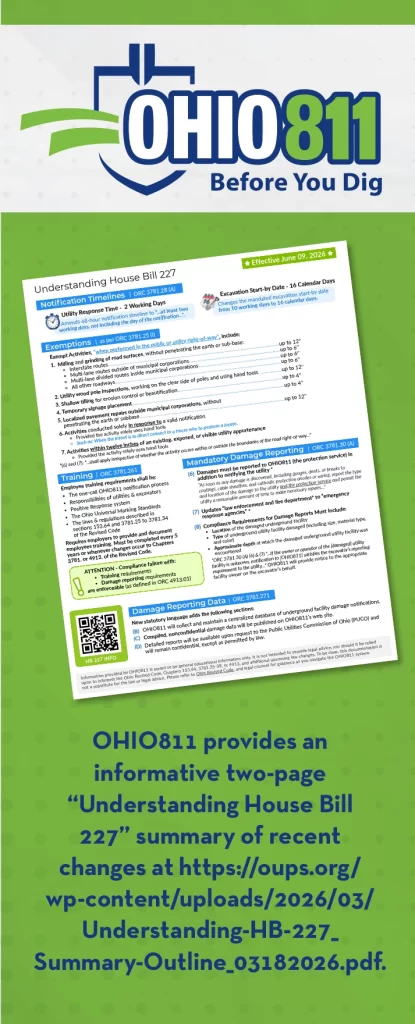
OHIO811 provides an informative two-page “Understanding House Bill 227” summary of recent changes.
Exemptions
HB 227 exempts certain activities that Coniglio refers to as “a win for everyone” – from contractor to utility locator to the traveling public.
Though HB227 still requires OHIO811 to be notified prior to breaking ground, there are seven activities within the public (e.g., road, sidewalk, trail, alley, etc.) or utility rights-of-way that are now able to occur without utilities needing to be marked. These exempted activities – with varying allowances for depth of penetration of earth or sub-base – include:
- Milling/Grinding of Road Surfaces
- Interstate routes up to 12 inches
- Multi-lane routes outside municipal corporations up to 6 inches
- Multi-lane divided routes inside municipal corporations up to 6 inches
- All other roadways up to 6 inches
- Utility Wood Pole Inspections
- Working on the clear side of poles and using hand tools up to 12 inches
- Shallow Tilling
- For erosion control/beautification up to 4 inches
- Temporary Signage Placement
- up to 4 inches
- Localized Pavement Repairs Outside Municipal Corporations
- Without penetrating earth/sub-base up to 12 inches
- Activities solely being Conducted in Response to a Valid Notification
- Provided the activity solely uses hand tools
- Such as when the intent is to direct connect to a tracer wire to perform a locate
- Activities within 12 inches of Existing, Exposed or Visible Utility Appurtenance
- Provided the activity solely uses hand tools
“By doing exemptions on the millings, that’s huge, that’s common sense,” said Coniglio, who added that prior to the amended regulations, contractors and utility locators were unnecessarily delaying projects because they were simply abiding by the rules. “(Workers) aren’t hitting lines when milling on the interstate,” he said. “The way the rules used to be, when you milled you were supposed to call in locates (to mark utilities), but there aren’t any utilities under the Interstate. But you still would have to call in and wait two days before you could begin milling …
“If anything, the exemptions help all the parties involved,” Coniglio adds. “We aren’t taking up resources for locators to locate three miles of Interstate highway where there aren’t any utilities on it anyway.”
Training
HB227 significantly increases the employer training now required to employees regarding excavation notifications and practices.
Where prior training centered on general safe digging and notification practices for field excavators and operators, training has been expanded to now include:
- OHIO811 processes;
- excavator/utility responsibilities;
- positive response systems;
- universal marking standards; and
- laws/regulations described in the ORC.
In addition to the expanded training itinerary covered in HB 227, employers must formally document and retain records of its successful completion. Companies must also re-train employees every five years – or when underground utility laws are revised. Employee training is required to include designers, developers, engineers and utility locators.
Coniglio said heavy/highway companies are providing HB227’s mandatory training in several ways. “(OHIO)811 is offering a lot of training … We’ve already had members of OCA contact us and we’ve made arrangements through 811 to have them go to our members and train them … Members have also been training their own groups.”
OHIO811 has developed a comprehensive suite of free training resources. The On PowerPoint presentation, on its dedicated webpage (www.OHIO811.org/HB227), explains the bill and highlights the specific ORC changes. Due to HB227’s expanded training requirements, OHIO811 has created additional resources, including a self-paced Learning Management System (LMS) module. “This module,” Broyles said, “is available at not cost on our website and has been integrated into several stakeholder organizations’ training platforms.” He also noted that OHIO811 Liaisons are available for in-person and webinar training.
Mandatory Damage Reporting & Data
As a result of HB227, there are new mandatory requirements for reporting damage to utilities as well as for the creation of data banks to be maintained by OHIO811.
Prior to June 9 and HB227 going into effect, when buried infrastructure – such as water, sewer, gas and electric lines – were struck or damaged, there wasn’t a centralized way of tracking the incidents. The new regulations introduce specific reporting mandates:
- Damages must be reported to OHIO811 in addition to notifying the utility provider
- Damages include gouges, dents or breaks to coatings, cable sheathes and cathodic protection anodes/wiring
- Updates “law enforcement and fire department” terminology to “emergency response agencies”
- Compliance Requirements for Damage Reports must Include:
- Location of damaged underground facility
- Type of underground utility facility that was damaged – which includes size, material and color
- Approximate depth of the encountered/damaged underground utility
When damages are reported, the data is collected/maintained by OHIO811. Nonconfidential damage data will be published on the OHIO811 website (https://oups.org). Detailed reports of the damage data will be available upon request to the Public Utilities Commission of Ohio and will remain confidential – except as permitted by law.
The “enforceable mandatory damage reporting” provides clearer, more consistent damage prevention processes. “Now there are going to be records of utility strikes where we can break it down to where it happened and what the activity was,” Coniglio said. “For instance, was it milling, or was it an excavator?”
Not So Quick
The relatively short time it took from legislation being sponsored by Representatives Monica Robb Blasdel (Columbiana) and Mark Johnson (Chillicothe) and HB227 being introduced last October to ultimately being signed into law by Gov. DeWine in early March, doesn’t recognize the work and lengthy timeline it took to formulate the legislation.
“I came to OCA in 2022,” said Coniglio, and the first (Ohio Underground Damage Prevention Coalition [OUDPC]) meeting that I attended we were talking about ‘the true 48 hours and 16 days’ … That language is now in House Bill 227. It took a long time.”
The OUDPC, which OCA’s office serves as the venue for its quarterly meetings, is a coalition promoting safe excavation practices and preventing underground utility damages in Ohio. OUDPC is comprised of members of the Ohio Utilities Protection Service (OUPS), public utilities and service providers, excavation contractors and construction companies, ODOT, local government and industry associations and advocacy groups.
Legislative Groundwork
Just as it did for HB227, OUDPC has laid the foundation for several pieces of state legislation over the years.
“The collaborative efforts and constructive dialogue achieved through the Ohio Underground Damage Prevention Coalition have been successful in many key pieces of underground damage prevention legislation …” said Broyles. “This ongoing success underscores the OUDPC’s proven model of uniting industry stakeholders and associations to champion meaningful improvements in Ohio’s damage prevention and safety laws. These results are achieved through extensive time, collaboration and dedication from all partners – particularly during the drafting of legislative language and throughout the legislative journey of HB227.”
Coniglio said HB227’s legislative journey was made smoother through the work of OUDPC. “What is supposed to happen happened,” he said. “Once it comes out of the coalition and all the parties are in agreement, it goes to the Statehouse and everyone is locked in arms and it makes it easier to push the legislation through.”
Logan So said OUDPC’s work and advocacy was not only critical for HB227’s passage, but so was the representation and work of heavy/highway construction industry members.
“Legislation is hard,” said Logan So. “It’s about advocating for your position and listening to the positions of other stakeholders. It’s about weighing risk … We, as contractors, needed to be at the table. I have been grateful for Dave Coniglio and (Legislative Director) Michelle Holdgreve’s participation from OCA as well as the countless others.” She also mentioned the work of Kokosing Construction Co. Inc.’s Clayton Heinz and Shelly & Sands Inc.’s Alex McCann, who co-chaired committees. “Did each of us get exactly what we wanted? No. But we worked toward a safer excavating community. We were heard as contractors, and we developed credibility with key stakeholders in the utility and locator communities, which will only help us as we continue working on future legislation.”
Coniglio believes HB227 becoming law proves not only that the voice of OUDPC is heard but also of the contracting members. “I think the success with HB227’s passage is proof that contractor participation in the OUDPC strengthens the coalition,” he said. “We’ve been rattling the cages, so to speak, to get contractors, especially our members, involved in these subcommittees, because these are things that directly affects our members … We’re really lobbying our members to get involved.”